
When Fishing Communities Defend the Ocean
The strongest evidence that marine protection works is not found in policy documents. It comes from the fishing communities, enforcement networks and NGO partnerships where illegal fishing has been met, and turned back. Neptune's Pirates is one of those stories.
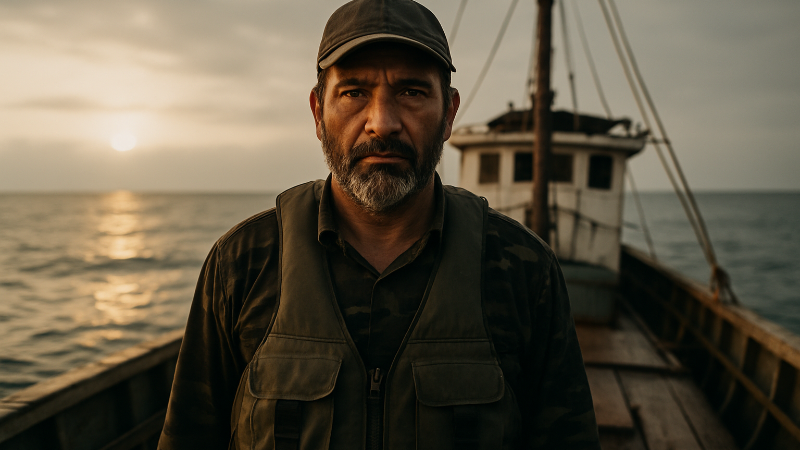
There is a particular kind of marine protection that does not appear on the 30x30 map and does not depend on ratification schedules. It depends on people who know the water, know who belongs there and know who does not. Across reef systems and coastal fisheries worldwide, that knowledge — when it is organised, resourced and backed by genuine legal authority — has produced some of the clearest evidence of what ocean recovery looks like in practice.
Neptune's Pirates works at the intersection of marine enforcement, community engagement and habitat protection. Their focus is the destruction of marine habitats by illegal fishing — the gear that tears through reef structure, the ghost nets that continue killing for years after the vessel that set them has moved on, the industrial pressure on fish populations that designated MPAs are supposed to prevent but frequently fail to. What organisations operating in this space have demonstrated, in measurable terms, is that enforcement changes behaviour. When fishing communities understand that a boundary will be held — not announced and then ignored — the dynamics around that boundary shift. Poaching pressure falls. Reef systems inside the protected zone begin to rebuild.
The spillover effect has been documented across multiple MPA systems. Fish populations inside no-take zones grow in density and diversity. Those populations eventually extend beyond the boundary, replenishing the adjacent fisheries that local communities depend on. Fishers who initially resisted the establishment of a protected area frequently become its most consistent advocates once that dynamic becomes apparent. The transition from extraction to stewardship is not sentimental. It is economic, and it is real.
What the footage from well-functioning reef systems shows — in the Great Barrier Reef documentary with Jenna Rumney, in the expedition work captured in Among The Corals — is the version of ocean life that effective protection makes possible. Sharks feeding through schools of fish. Coral structures dense enough to hold the visual complexity of a city. An ecosystem that is loud, in the specific sense that a healthy reef is loud: the constant crackling of millions of snapping shrimp, the sound of a system that is running. That sound is what disappears first from a degraded reef, and what comes back, given time and genuine protection, before almost anything else.
The Ecoflix Foundation works directly with conservation partners including Neptune's Pirates to fund the field operations that make the difference between an MPA that functions and one that does not. Every donation made through Ecoflix goes directly to those partners — no administration fee, no overhead deduction. One hundred per cent reaches the field. The case for that model does not rest on principle alone. It rests on the reefs that came back, the fishing communities that switched sides and the ghost nets that were pulled before they could do the next decade of damage.
Support the Ecoflix Foundation and its NGO partners. Every donation goes directly to the field. Join at watch.ecoflix.com
First published in the Ecoflix newsroom.
More in Ecoflix Impact

The Land That Came Back to Life
On World Environment Day 2026, the most powerful argument for nature-based climate action is not a projection or a policy paper. It is the evidence of what communities have already done — on three continents, with their own hands and their own land.
Read feature
Why Beavers Are Already Doing the Job Policy Hasn’t
Beaver reintroductions in Britain have moved faster than legislation, faster than expectation, and produced measurable ecological change in a handful of years. The evidence is now harder to ignore than the politics around it.
Read feature
The Species That Came Back From the Edge
Endangered Species Day is not only a reckoning with what is being lost. It is a record of what has been saved — and the evidence from the field is more encouraging than the headlines suggest, provided the intervention comes early enough.
Read feature