
How Darkness Became a Conservation Tool
The science behind seabird rescue is more intricate than it looks from the street. From acoustic monitoring to GPS-tracked releases and tunable LED systems dimmed after midnight, the field methodology is reshaping how conservationists think about light, time and the design of coastal towns.
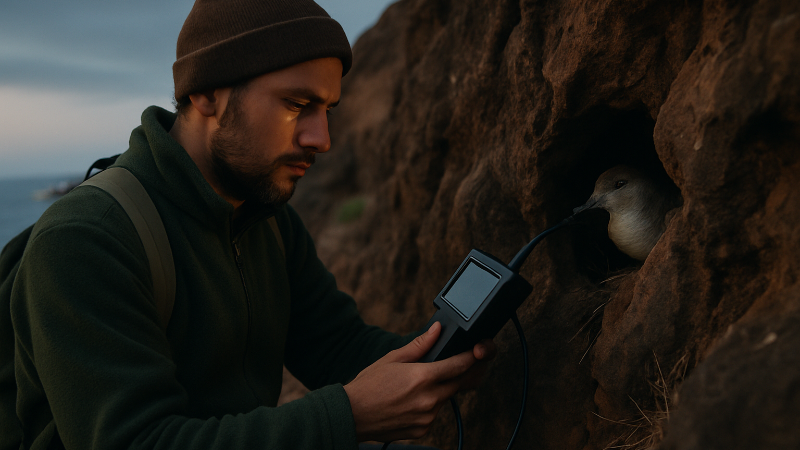
On a rocky hillside above Funchal, a researcher named Manuel threads a boroscope — a small, flexible camera on a cable — into a crevice in the cliff face without touching the birds inside. It is how the team checks nest status without disturbing a colony whose exact location they will not disclose publicly, because poachers still climb these cliffs to take birds for food. Conservation work, on Madeira at least, operates in the dark by necessity as much as by method.
The nocturnal methodology built around Cory's Shearwater recovery is more layered than the headline intervention suggests. Yes, the single most effective action is reducing light during the October and early November migration window. But the science sitting beneath that single action involves acoustic monitoring to track where grounded birds are calling, GPS trackers fitted to recovered individuals to verify post-release behaviour, burrow surveys conducted at night to avoid diurnal predators, and ongoing data collection from weighing, measuring and tagging each rescued bird before release. A tracker costs 1,000 euros. The data it returns — in this case, a recovered juvenile flying straight to sea and staying there — is the proof of concept the conservation case depends on.
The lighting question itself has become a genuine technical field. Municipalities that switch sodium street lamps for tunable LED systems and dim them after midnight can save up to 50 per cent on public lighting bills while eliminating the wavelengths most disorienting to seabirds. On Corvo, population 300, a full 15-day blackout during migration has produced zero fallouts. In Machico on Madeira, a partial blackout that leaves some streets lit produces birds that keep falling on the lit sections. The data is unambiguous. The resistance comes not from the science but from residents who associate light with security and find the conservation argument abstract when set against their electricity bills and their sense of what a modern town should look like at night.
The Ergonomic Ape, the second Ecoflix film anchoring this week's programming, widens the frame in a way that makes the resistance easier to understand. The film's central argument, led by academic author Ivan Crow, is that the human instinct to extract more usable energy from the environment is the defining impulse of the species — the same cognitive and anatomical drive that produced fire, agriculture, water mills, steam and ultimately fossil fuels. Light pollution is a relatively trivial output of that drive, but it is entirely consistent with it. Turning lights off requires going against an instinct that is, in the most literal evolutionary sense, six million years old.
That context does not make the conservation problem harder to solve. It makes the solution more interesting. The communities on Madeira that do reduce their lighting are not denying themselves something essential. They are making a calibrated trade: a short, predictable seasonal adjustment in exchange for a population of long-lived seabirds that will still be breeding on those cliffs in 40 years. The science supports that trade. The question is whether the persuasion can keep pace with the pressure.
Stream Be Brave To Act - Episode 2 Saving Seabirds At Night and support the work of our conservation partners at https://watch.ecoflix.com/programs/bbta_ep2_saving_seabirds_at_night
First published in the Ecoflix newsroom.
More in Conservation
Why Nature Is Now a Climate Strategy
This week marks World Environment Day 2026, themed Inspired by Nature. Behind the slogan is a growing body of evidence that restored ecosystems are among the most powerful climate tools available — and some of the least used.
Read feature
What 35,000 Square Kilometres Can Teach Us
In the 1990s, China's Loess Plateau was the most eroded place on Earth. What happened next is one of the most documented and significant acts of ecological recovery ever recorded — and its lessons apply far beyond China's borders.
Read feature
The Activists Holding Ocean Destroyers to Account
From Grenada's reefs to the killing bays of the Faroe Islands, the front line of ocean protection is held by a small number of organisations willing to go where others do not. What they find there is both troubling and clarifying.
Read feature