
Inside the Citizen-Science Push to Heal the Hudson
For two decades, a single river-keeper organization has built one of the largest watershed-scale monitoring efforts in the United States. The data it generates has begun to change what river recovery looks like.

For two decades, a single river-keeper organization has built one of the largest watershed-scale monitoring efforts in the United States. The data it generates has begun to change what river recovery looks like.
Each Thursday morning along the Hudson River and the creeks that feed into it, around 170 volunteers walk to a designated patch of water with a small bottle, a pair of gloves and a sampling sheet. By the end of the day, they will have collected somewhere in the order of 110 samples, part of a monthly total that runs past 440. The results are processed by Friday evening and posted publicly before the weekend, when most of the river’s swimmers, kayakers and rowers are likely to use it. Twenty-five years ago this work did not exist.
The figure that does the most editorial heavy lifting in Hope On The Hudson: Source to Sea is unprepossessing on the surface. Around 80 percent of the samples now collected across more than 800 miles of the Hudson watershed test clean enough for swimming. That number is a long way from the river’s 1970s reputation, when going into the Hudson was a thing children along the banks were warned against. The improvement carries the fingerprints of two slow forces: federal regulation following the Clean Water Act and the kind of patient, granular monitoring that does not show up easily in a headline.
Behind the headline figure sits one of the better-known river keepers in the United States, John Lipscomb, who began patrolling the Hudson in 2000. There is no manual, he notes early in the film, for how to protect a river. What he and the team around him built instead was a question, asked over and over by the public and embarrassingly hard to answer: how is the water? The answer, until the citizen-science program began, was that nobody really knew. The first clear finding from the monitoring work was counter-intuitive enough to define everything that followed: the small, picturesque tributaries flowing into the Hudson were often more contaminated than the muddy main channel. The pretty creeks were the problem. The dirty river had begun to clean itself.
That insight reframed the river-recovery question across the watershed. Rather than treating the Hudson as a single body to be cleaned, the work moved outward to each contributing tributary, each town’s stormwater system, each combined-sewer overflow point upstream of the capital district. Citizen scientists, recruited in part through a program built around recreational swimmers asking simple questions about their own water, became the data engine. Their range was something a state environmental agency, with its budgets and procurement cycles, would struggle to match. Their cost was something an academic field program could not get close to.
Other parts of the watershed economy began to follow the data. Drinking water utilities along the Hudson, including the system serving roughly 100,000 people in and around Poughkeepsie, now draw on a real-time picture of source-water quality. A craft brewery in the Hudson Valley draws its water directly from the river and makes a quiet point of saying so. A six-and-a-half-mile open-water swim from Yonkers to Inwood now attracts 200 swimmers from around the world. None of these activities would be conceivable on a river that had stayed in its 1970s state.
The same logic, applied at smaller scale, drives the work in Cornwall captured in Sneak Peak: Rewilding The Riverbank. There the equivalent of citizen monitoring is the camera trap, the floating mink raft and the daily visit to a network of freshwater ponds. The species being measured is the water vole rather than enterococci bacteria, but the underlying principle is identical: build a slow, locally rooted picture of the system, share it widely and let recovery rebuild from the bottom up.
Watershed-scale monitoring is not a glamorous instrument of conservation. It is unusually effective.
What sits behind both films is the same observation, often understated, that ecosystems repair themselves at a pace that surprises even the people doing the work, provided the work itself is patient and granular and continues for long enough. The data, slowly, becomes the case for protection.
Stream Hope On The Hudson: Source to Sea and support the work of our conservation partners.
External Links
Riverkeeper — riverkeeper.org | NOAA — noaa.gov
First published in the Ecoflix newsroom.
More in Science
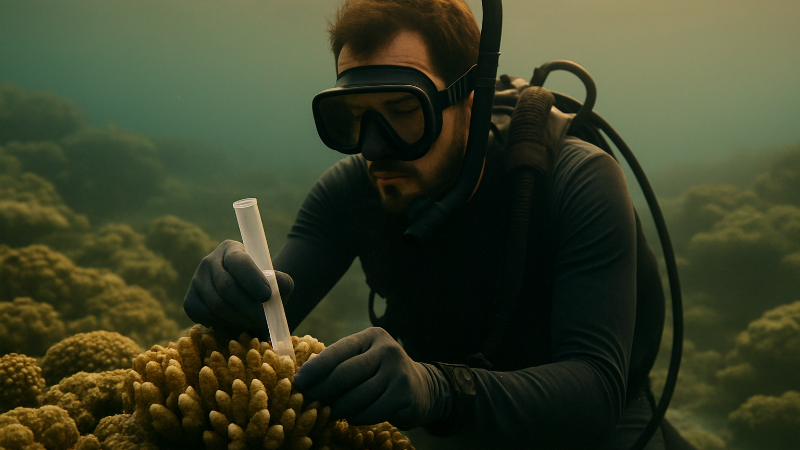
What Super Corals Reveal About Reef Recovery
In the tropical eastern Pacific, a team of scientists is sampling the same corals twice a year, chasing a question that could reshape how the world thinks about ocean restoration. Some reefs are fighting back — and the science of why is finally catching up.
Read feature
What SARS Still Has to Tell Us About the Wildlife Trade
Palm civets were implicated in the 2002 SARS outbreak. Two decades on, the science linking their exploitation to zoonotic disease risk has never been clearer.
Read feature
Endangered Species Day is not just about endangered species
Ian Redmond explores how endangered gorillas influence forest regeneration, insect life, rainfall systems and carbon storage, showing why species loss affects ecosystems far beyond their immediate habitat.
Read feature