
What Super Corals Reveal About Reef Recovery
In the tropical eastern Pacific, a team of scientists is sampling the same corals twice a year, chasing a question that could reshape how the world thinks about ocean restoration. Some reefs are fighting back — and the science of why is finally catching up.
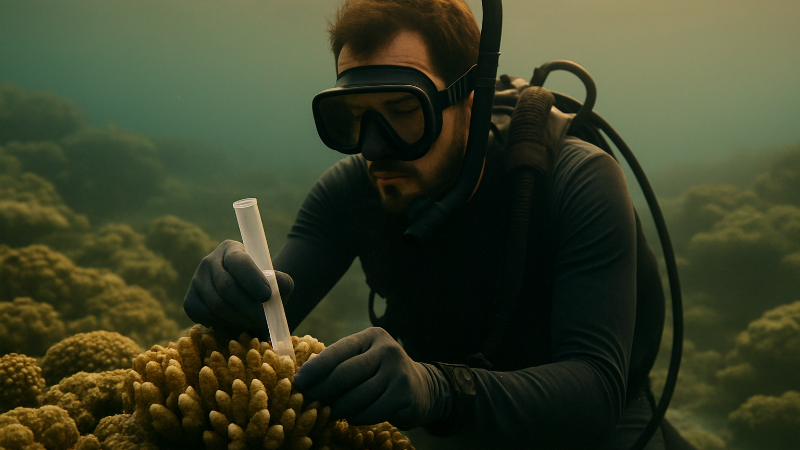
Open your eyes underwater on a healthy coral reef and the comparison that comes to mind is not natural history — it is urban architecture. One researcher who has spent more than two decades studying reefs puts it this way: think of coral like a skyscraper, every floor, every room, every gap between walls occupied by a different creature finding its niche. Remove the building and you do not just lose the structure. You displace everyone inside it.
The question driving a long-running expedition in coastal Panama is more specific than reef survival in the abstract. The team — at least six nationalities, working in the tropical eastern Pacific through both dry and rainy seasons — is looking for corals that have already survived conditions most reefs have not. This stretch of ocean experiences dramatic swings in temperature and environmental stress. Over evolutionary time, that pressure appears to have selected for toughness. The hypothesis is that these corals carry biological traits that could inform restoration work across the wider ocean.
Identifying those traits requires a methodology that is simultaneously painstaking and genuinely inventive. Divers lay transects along the reef floor, tagging individual coral colonies so that the same organism is sampled at every return. Tiny pieces are taken, flash-frozen in liquid nitrogen, and carried back to onboard laboratories. Meanwhile, 5,000 photographs per swim are stitched together using software originally developed in Silicon Valley to produce 3D photomosaic maps of the reef — 50 metres long, four metres wide, detailed enough to track ecological change across seasons and years. Fixed underwater cameras record fish behaviour undisturbed by human presence, filling the gaps that direct observation cannot reach. Environmental DNA sampling, filtering water for the genetic traces left behind by scales, mucus and other particles, provides a broader census of reef life than any visual survey alone.
The ambition of the project is matched by its timescale. The research is designed to run for four years at minimum and will likely extend across the careers of the scientists involved. This is not a criticism; it is the point. Coral reef ecosystems change on long cycles, and understanding them requires patience that most research funding frameworks struggle to accommodate. "Not just the corals have to be resilient," one team member observed. "The scientists have to be resilient as well."
What the Great Barrier Reef, documented in the Ecoflix film by marine biologist Jenna Rumney, shows alongside this Panamanian work is that abundance is still possible. The reef Rumney explores — its parrotfish, its sharks, its layered communities of invertebrates — demonstrates what a functioning marine ecosystem looks like when it is given sufficient protection from direct pressure. The super coral research asks what it takes to hold that system together as temperatures rise.
The two questions are connected. Protection without restoration may not be enough for the reefs most severely damaged by bleaching events. Restoration without protection is futile. The science coming out of Panama and Queensland points toward an integrated model: identify the organisms most likely to survive, understand why, replant where the conditions allow, and then — critically — hold the boundary.
Stream Among The Corals and support the work of our conservation partners at https://watch.ecoflix.com/programs/among-the-corals
First published in the Ecoflix newsroom.
More in Science

What SARS Still Has to Tell Us About the Wildlife Trade
Palm civets were implicated in the 2002 SARS outbreak. Two decades on, the science linking their exploitation to zoonotic disease risk has never been clearer.
Read feature
Inside the Citizen-Science Push to Heal the Hudson
For two decades, a single river-keeper organization has built one of the largest watershed-scale monitoring efforts in the United States. The data it generates has begun to change what river recovery looks like.
Read feature
Endangered Species Day is not just about endangered species
Ian Redmond explores how endangered gorillas influence forest regeneration, insect life, rainfall systems and carbon storage, showing why species loss affects ecosystems far beyond their immediate habitat.
Read feature